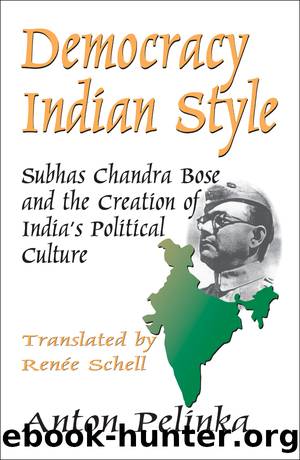
Democracy Indian Style: Subhas Chandra Bose and the Creation of India's Political Culture by Anton Pelinka
Author:Anton Pelinka [Pelinka, Anton]
Language: eng
Format: epub
Tags: Political Science, Political Ideologies, Democracy, History, Asia, General, Political Process
ISBN: 9780765801869
Google: M6gLpMf5-jwC
Goodreads: 6074468
Publisher: Transaction Publishers
Published: 2003-01-15T08:07:04+00:00
8
No PartiesâOr Too Many Parties?
Ramakrishna Hedge, the former chief minister of Karnataka from the ranks of the Janata Dal, entitled his contribution to the volume India at 50 âEgos, Not Parties.â Hedge recounts Indiaâs successes in the first fifty years of independence: agriculture, industry, education, and many other sectors. But in one area, he wrote, India has failed: âhalf a century since India became free, there is yet no stable party systemâ (Hedge 1997: 49).
Indeed, Indiaâs party system has been characterized since the beginning by the hegemony of a single party surrounded by smaller parties that proved no real competitionâsimilar to the party systems of Japan, Italy, and Mexico at that same time. For decades in Japan it was not possible to build a majority without the Liberal Democratic Party; in Italy between 1948 and the early 1990s the Democrazia Cristiana was necessary for a parliamentary majority; and in Mexico the Party of the Institutionalized Revolutionâthe PRIâcontrolled the central political system as the permanent party of government until the year 2000, despite the existence of other parties. The Indian party system was similar during the period 1947â1977: in the beginning was the Congress Party, then came the Congress again; all other parties were of tertiary importance.
The hegemony of the Congress Party can be explained primarily in terms of the history of the independence movement. The Congress Party shares direct continuity with the National Congress. The Congress founded the state; the Congress defined the political identity of India. This was the basis for the hegemony of the Congress Party during the first thirty years of the history of Indian democracy.
This continuity is symbolized by the dynasty of Jawaharlal Nehru, who was able to draw on his appeal as the direct successor to Gandhi. Before 1947 the Congress was the only real force that could speak for India, not just for a segment of Indiaâs population. For decades thereafter the Congress Party was the only relevant party that could not be reduced to a certain region or religion.
Download
This site does not store any files on its server. We only index and link to content provided by other sites. Please contact the content providers to delete copyright contents if any and email us, we'll remove relevant links or contents immediately.
Personalized inhaled bacteriophage therapy for treatment of multidrug-resistant Pseudomonas aeruginosa in cystic fibrosis by unknow(174689)
CONSORT 2025 statement: updated guideline for reporting randomized trials by unknow(83105)
Critical evaluation of the ProfiLER-02 study design and outcomes by Vivek Subbiah & Razelle Kurzrock(82771)
Cardiac gene therapy makes a comeback by Oliver J. Müller & Susanne Hille & Anca Kliesow Remes(82600)
Whisky: Malt Whiskies of Scotland (Collins Little Books) by dominic roskrow(74436)
Unveiling the design rules for tunable emission in graphene quantum dots: A high-throughput TDDFT and machine learning perspective by Şener Özönder & Mustafa Coşkun Özdemir & Caner Ünlü(50890)
A yeast-based oral therapeutic delivers immune checkpoint inhibitors to reduce intestinal tumor burden by unknow(40259)
Covalent hitchhikers guide proteins to the nucleus by Alexander F. Russell & Madeline F. Currie & Champak Chatterjee(40215)
Meet the Authors: Christopher R. Mansfield and Emily R. Derbyshire by Christopher R. Mansfield & Emily R. Derbyshire(40093)
Alkaline-earth metals promote propane dehydrogenation with carbon dioxide through geometric effects: Altering the reaction pathway by unknow(32729)
Induced iron vacancies boosting FeOOH loaded on sustainable Fenton-like collagen fiber membrane for efficient removal of emerging contaminants by unknow(32504)
Efficient electric-field-assisted photochemical conversion of methane to n-propanol exclusively over penetrated TiO2Ti hollow fibers by Guanghui Feng(32452)
Bi2SiO5 nanosheets as piezo-photocatalyst for efficient degradation of 2,4-Dichlorophenol by Hangyu Shi & Yifu Li & Lishan Zhang & Guoguan Liu & Qian Zhang & Xuan Ru & Shan Zhong(32383)
A novel NDIPTA organic heterojunction photocatalyst with built-in electric field for efficient hydrogen production by Jiahui Yang & Baojun Ma & Yongfa Zhu(32360)
Enhanced conversion of methane to liquid-phase oxygenates via hollow ferrite nanotube@horseradish peroxidase based photoenzymatic catalysis by Jun Duan & Shiying Fan & Xinyong Li & Shaomin Liu(32330)
Ordered macroporous superstructure of defective carbon adorned with tiny cobalt sulfide for selective electrocatalytic hydrogenation of cinnamaldehyde by Xiao-Shi Yuan & Sheng-Hua Zhou & San-Mei Wang & Wenbo Wei & Xiaofang Li & Xin-Tao Wu & Qi-Long Zhu(32256)
What's Done in Darkness by Kayla Perrin(27144)
Topological analysis of non-conjugated ethylene oxide cored dendrimers decorated with tetraphenylethylene: Insights from degree-based descriptors using the polynomial approach by A Theertha Nair & D Antony Xavier & Annmaria Baby & S Akhila(26522)
Investigation of mechanical and self-healing properties of hydroxyl-terminated polybutadiene functionalized with 2-ureido-4-pyrimidinone by Mohsen Kazazi & Mehran Hayaty & Ali Mousaviazar(26457)
